
Compliance
Billing Advance Care Planning Right: 99497 and 99498
ACP has no frequency limit, but every claim has to describe a real conversation. Most ACP denials come from the note, not the code.
In this article
Advance care planning (ACP) is one of the few E/M-side services with no frequency limit. It can be billed in any setting and on the same day as most visits. That is exactly why auditors watch it closely. This post covers the time rules, what the note must show, and the mistakes that most often turn an ACP claim into an overpayment.
Part 1 of 8
What advance care planning is
ACP is a face-to-face conversation between a billing practitioner and the patient, a family member, a caregiver or a surrogate about the care the patient would want if they could no longer decide for themselves. It can include explaining and completing advance directives:
- a health care proxy (durable power of attorney for health care)
- a living will
- a do-not-resuscitate (DNR) order
- medical orders for life-sustaining treatment, such as a POLST or MOLST
Medicare pays for ACP under the Physician Fee Schedule with two time-based codes:
| Code | Description | Notes |
|---|---|---|
99497 | First 30 minutes of ACP, including explaining and discussing advance directives | Once per encounter, from 16 minutes |
+99498 | Each additional 30 minutes of ACP | Add-on: only with 99497 |
Part 2 of 8
How time turns into units
ACP is billed by time. A unit counts once you pass the midpoint of its 30 minutes, so 99497 starts at minute 16. Fifteen minutes or less can't be billed as ACP; count that time toward the E/M visit instead.
Picture it · the ACP clock
ACP minutes · one encounter
12 minutes of ACP
No ACP code
Not billable as ACP
22 minutes of ACP
99497One unit
50 minutes of ACP
99497+99498Base + one add-on
80 minutes of ACP
99497+99498 ×2Base + two add-ons
16 minutes is the line. Short talks at different visits can't be added together: each billed encounter needs its own 16 minutes.
| ACP minutes | What to report |
|---|---|
| 15 or less | No ACP code |
| 16–45 | 99497 × 1 |
| 46–75 | 99497 + 99498 × 1 |
| 76–105 | 99497 + 99498 × 2 |
Part 3 of 8
What every ACP note must show
CMS lists four required elements. Contractor guidance adds a fifth: what was actually discussed and decided. A note with all five will hold up in an audit.
- Voluntary. The patient, family member or surrogate agreed to have the conversation, and the note says so.
- Advance directives explained. Which documents or options were discussed, and any forms completed.
- Who was present. Each participant by name or relationship. If the patient didn't take part, say why (for example, lacks capacity).
- Time. Face-to-face minutes spent on ACP only. Start and stop times are best practice.
- Content and outcome. The patient's values, goals and wishes, the decisions made, and any change to code status or treatment limits.
Audit it · two ACP notes, five checks
Won't hold up
An additional 20 minutes were spent with the patient/staff performing advance care planning strategies. Code status: full code.
- Voluntary · No agreement recorded
- Directives explained · No document or option named
- Who was present · “Staff” isn't a family member or surrogate
- ACP-only time · 20 minutes, but no start/stop and could overlap the visit
- What was decided · Same code status as last time, nothing decided
0 of 5 → don't bill ACP
Supports 99497
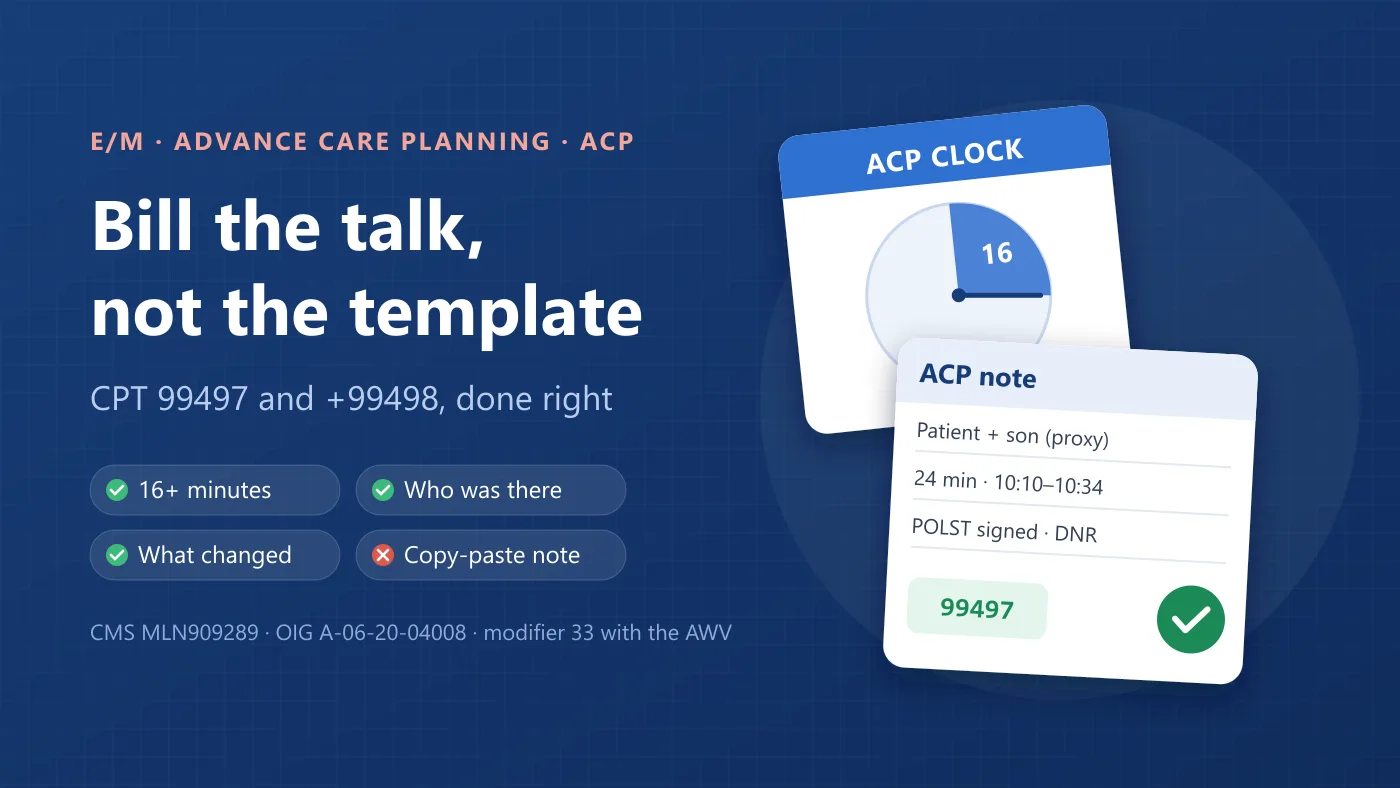
With the patient's agreement, discussed ACP with the patient and son (health care proxy) for 24 minutes (10:10–10:34), separate from today's E/M. Explained the proxy form, POLST, CPR and ventilator options. After a fall with hip fracture last month, the patient chose DNR and no intubation. POLST completed and signed.
- Voluntary · “With the patient's agreement”
- Directives explained · Proxy, POLST, CPR, ventilator
- Who was present · Patient and son (proxy)
- ACP-only time · 24 minutes, 10:10–10:34, separate from E/M
- What was decided · New DNR choice after a new event
5 of 5 → bill 99497
Part 4 of 8
How often ACP can be billed
Neither CPT nor CMS sets a frequency limit. A patient whose illness is getting worse may need several conversations in a year. But every repeat comes with one condition:
Examples of a documented change: a new serious diagnosis, a hospital stay, a decline in function, becoming eligible for hospice, a new surrogate, or the patient changing their code status or treatment choices.
Part 5 of 8
Settings, same-day services and who can bill
Place of service
There are no place-of-service limits. ACP can be billed in an office, hospital, skilled nursing facility, nursing home, the patient's home, or by telehealth under the rules in effect on the date of service. ACP is excluded from SNF consolidated billing, so the practitioner bills it separately.
With an E/M visit
ACP can be billed on the same day as most E/M services, including nursing facility visits, and during TCM, CCM and global surgical periods. Add modifier 25 to the E/M visit when its requirements are met.
With the Annual Wellness Visit
When ACP is done on the same day as a covered AWV (G0438 or G0439), by the same provider and on the same claim, add modifier 33 to the ACP code. Medicare then waives the patient's deductible and coinsurance for the ACP. Outside the AWV, normal cost-sharing applies.
Claim A
ACP with the AWV
G0439subsequent AWVPaid99497-33no copayPaid
Same day, same provider, same claim, modifier 33: the patient pays nothing for the ACP.
Claim B
ACP with critical care
99291critical carePaid99497same dateDenied
The same practitioner can't report ACP on the same date as critical care.
Codes you can't bill with ACP
The same practitioner can't report ACP on the same date as:
- critical care (99291–99292)
- neonatal and pediatric critical and intensive care (99468–99480)
- cognitive assessment and care planning (99483)
Who can bill
Physicians and qualified non-physician practitioners (NPs, PAs and CNSs) can bill ACP. Clinical staff may help under the practitioner's direction and incident-to rules, but the billing practitioner has to take a real part in the conversation. Social workers and chaplains can't bill ACP on their own.
Part 6 of 8
What the OIG audit found
In November 2022 the HHS Office of Inspector General reported on ACP billed in office settings in 2019. It reviewed 691 paid ACP services for a random sample of 125 patients, drawn from about 873,000 patients and $70.1 million in payments.
| Finding | Result |
|---|---|
| Sampled services that didn't meet the rules | 466 of 691 (67%) |
| Estimated improper payments, one year, office setting only | $42.3 million |
| Patients with 15 or more ACP services in 12 months | Flagged as questionable |
Where the claims went wrong:
- 268 services: ACP was documented, but the note didn't separate ACP time from the rest of the visit. One note gave a single "35 minutes" for the history, exam, medication review and advance directives together.
- 174 services: the record didn't show that an ACP conversation happened at all, and gave no separate ACP time.
- Repeat billing: 12 sampled patients had 15 or more ACP services in a year, with no documented change in health status or wishes.
The OIG concluded that providers didn't understand the billing rules for ACP, and asked CMS to educate providers and recover the overpayments. Under the 60-day rule, a provider who finds an overpayment must report and return it within 60 days.
Part 7 of 8
The mistakes auditors see again and again
Most ACP denials are documentation problems, not coding errors:
- Template time statements. The same sentence ("an additional 20 minutes were spent on advance care planning") appears in every visit, with nothing about what was discussed.
- The wrong people. "Spent with patient/staff." A talk with facility staff isn't ACP. ACP is a conversation with the patient, family or surrogate.
- Quality-measure lines billed as ACP. "Advance care plan is on file" supports a quality measure. It doesn't show that ACP took place.
- Repeat billing with no change. ACP on visit after visit, sometimes on back-to-back days, while code status and wishes stay the same.
- Overlapping time. ACP minutes counted inside time already used to pick the E/M level.
Part 8 of 8
Questions coders ask
Does a form have to be completed to bill ACP?
No. The codes cover completing forms "when performed". A documented conversation with no new form still qualifies.
Can ACP be billed when the patient isn't present?
Yes. The conversation can be with a family member or surrogate. The note must say why the patient couldn't take part.
Can I add up short ACP talks from several visits?
No. Time is counted per encounter. Each billed encounter needs at least 16 minutes of ACP on its own.
Does ACP need a specific diagnosis code?
No. Report the condition that was addressed. With an AWV, use the same diagnosis as the AWV.
Is ACP limited to once a year?
No. There is no frequency limit, but each repeat should show a change in the patient's health or wishes.
End of the article: check what you remember