
Evaluation & Management
Assisted Living Visits: Monthly Check-In or Billable E/M?
Thirty days passing isn't a reason to bill a visit. Active decision-making about the patient's conditions is.
In this article
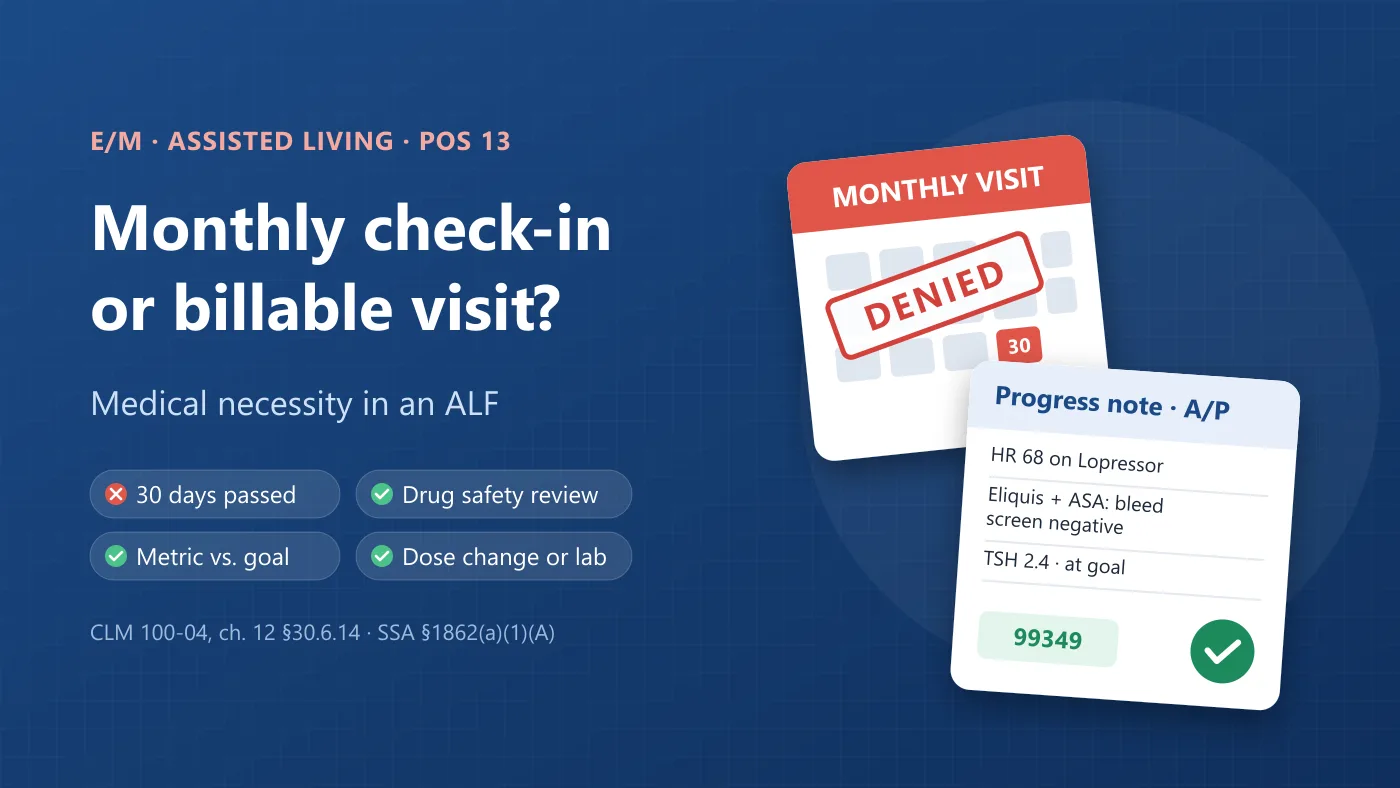
Assisted living facilities (ALFs) often ask providers to see every resident once a month, or to sign a periodic "medical recertification" note. Coders then get the question: can we bill an E/M visit for it? Not when the visit happens only because the calendar says so. If the patient is at baseline, meeting every treatment goal, has no drug-safety screening due, no labs to review and needs no decisions made today, there is nothing medically necessary to bill as an in-person E/M visit.
A stable chronic condition can still support a billable visit, though, when the encounter is driven by real decision-making: drug safety, risk monitoring, or checking a measurement against the patient's goal. This post explains the difference, compares two notes for the same patient, and works through eight real-world scenarios.
Part 1 of 6
An ALF is the patient's residence
For Medicare Part B, an assisted living facility is a residence, not a nursing facility. The Claims Processing Manual, Chapter 12, §30.6.14 says E/M services to a patient "residing in their home, in an assisted living facility, in a group home…" are reported with the home or residence codes (99341–99350), with place of service 13 (Assisted Living Facility). The old domiciliary and rest home codes (99324–99337) were deleted on January 1, 2023, so there is no separate "ALF visit" or "monthly assessment" code. Nursing facility codes (99304–99310) can't be used for POS 13.
That matters because nursing facilities and ALFs work under different rules:
- Skilled nursing and nursing facilities: Chapter 12, §30.6.13 describes federally mandated physician visits (under 42 CFR 483.40), reported with the nursing facility codes. Even there, the mandated visit is a separate idea from a medically necessary one: §30.6.13 says the mandated visit "may serve also as a medically necessary E/M visit" only if the patient has health problems that need attention that day.
- Assisted living: §30.6.14 describes no mandated visit schedule for ALF residents. A "routine monthly check-in" or a "medical recertification note" has no Medicare visit benefit behind it.
What happens to a calendar-driven claim
Medicare only pays for services that are reasonable and necessary for the diagnosis or treatment of illness or injury (Social Security Act §1862(a)(1)(A)). Chapter 12, §30.6.1(B) calls medical necessity "the overarching criterion for payment in addition to the individual requirements of an E/M visit code," and adds that "the volume of documentation should not be the primary influence" on the level billed. So if an auditor sees a visit done only because 30 days have passed, the claim can be denied and the payment recouped, however long the chronic problem list is.
Done: Why routine ALF visits aren't covered
Part 2 of 6
You don't need an acute complaint
Chest pain or shortness of breath isn't required to bill an E/M visit. A stable or chronic condition supports a billable encounter when one of these clinical triggers is present.
1. High-risk medication or combination therapy review
Example: a patient takes Eliquis and aspirin after a stroke (CVA) with atrial fibrillation. An anticoagulant plus an antiplatelet carries a high risk of major bleeding. Seeing the patient specifically to screen for occult bleeding (bruising, blood in the urine, dark stools), assess fall and head-injury risk, and decide whether dual therapy is still indicated is active prescription drug management.
2. A measurement off the patient's goal
Having no symptoms doesn't mean the patient is at goal. If the patient feels fine but the blood pressure is 142/88 mmHg, or the resting heart rate on Lopressor is 92 bpm, the condition is off target. CPT treats a chronic illness that isn't at its treatment goal as not stable. Evaluating that number and documenting why you're changing therapy, or why you're deliberately not increasing the dose (for example, because of fall risk), is active management.
3. Planned follow-up for a dose change or lab result
If Synthroid or Lopressor was recently adjusted, or a lab due for drug safety (a TSH or a kidney panel, for example) is being reviewed, the visit is justified to assess the response to treatment and how well the drug is tolerated.
Done: When a chronic condition justifies a visit
Part 3 of 6
Same patient, two different notes
Patient profile: atrial fibrillation (Lopressor, Eliquis), hyperlipidemia (Lipitor), history of CVA (aspirin), hypothyroidism (Synthroid). Assisted living resident.
Example A · not billableRoutine monthly follow-upOpen caseClose
CC: Monthly follow-up.
HPI: Patient seen for routine monthly assessment. Denies CP, SOB, palpitations. Feels at baseline.
A/P:
- A-fib: Stable. Continue Lopressor and Eliquis.
- HLD: Stable. Continue Lipitor.
- CVA: Stable. Continue ASA.
- Hypothyroidism: Stable. Continue Synthroid.
Your turn: code this case
Example B · billableFollow-up of a high-risk anticoagulant/antiplatelet regimen and rate controlOpen caseClose
CC: Follow-up evaluation for high-risk anticoagulant/antiplatelet regimen and rate control.
HPI: Patient presents for scheduled evaluation of chronic conditions. Denies acute CP, SOB or palpitations.
Exam/vitals: BP 128/78, HR 68 (regular). Skin: no new ecchymosis or petechiae.
A/P:
- Atrial fibrillation and history of CVA: Resting HR 68 bpm on Lopressor 50 mg BID, showing adequate rate control. Reviewed high bleeding risk from concurrent Eliquis 5 mg BID and aspirin 81 mg daily. Screened for occult bleeding: no gingival bleeding, hematuria or dark stools reported. Fall risk assessed; resident is steady with walker. Benefit of dual therapy continues to outweigh bleeding risk after CVA. Continue current regimen.
- Hypothyroidism: TSH 2 weeks ago was 2.4 mIU/L (at goal). Denies fatigue, cold intolerance or weight change. Continue Synthroid 75 mcg daily.
- Hyperlipidemia: Tolerating Lipitor 20 mg daily without myalgias or muscle weakness. Continue.
Your turn: code this case
Done: Two notes compared
Part 4 of 6
Real-world ALF scenarios
These are the situations coders see most in assisted living charts. Each one uses the same rules: POS 13 and the home or residence codes (Chapter 12, §30.6.14), and medical necessity first (§30.6.1). For established patients the codes are 99347 (straightforward), 99348 (low), 99349 (moderate) and 99350 (high). For new patients they are 99341, 99342, 99344 and 99345 (99343 was deleted in 2023).
Scenario 1 · off-goal blood pressureFeels fine, but BP is 146/90 on the monthly roundOpen caseClose
CC: Follow-up of hypertension; BP above goal on facility logs.
HPI: 84-year-old resident with hypertension, atrial fibrillation on Eliquis 5 mg BID, and two falls in the last 3 months. No headache, chest pain or vision change. Facility BP log for 2 weeks: 140s–150s/80s–90s.
Exam: BP 146/90 seated, 128/78 standing with dizziness. HR 72, irregular.
A/P: Hypertension not at goal (under 140/90). Orthostatic drop with symptoms and recent falls. Will not increase amlodipine 5 mg today: risk of further falls on an anticoagulant outweighs the benefit of tighter control. Nursing to check orthostatic vitals twice weekly; recheck in 4 weeks. Continue Eliquis 5 mg BID.
Your turn: code this case
Scenario 2 · recertification formFacility sends the annual recertification formOpen caseClose
The ALF faxes its annual "medical recertification / level of care" form. The resident is at baseline and meets all treatment goals; there are no new labs and no medication questions. The provider reviews the chart, signs the form and doesn't see the patient.
Your turn: code this case
Scenario 3 · after a dose changeTwo weeks after Lopressor was increasedOpen caseClose
CC: Follow-up after metoprolol tartrate increase for rate control.
HPI: Atrial fibrillation; resting HR was 98 at the last visit, so Lopressor was increased from 25 mg to 50 mg BID. Since then, no dizziness, syncope or falls. Hypothyroidism on Synthroid 75 mcg; TSH last week 2.1.
Exam: HR 70, irregular. BP 124/76 with no orthostatic drop.
A/P:
- Atrial fibrillation: rate now controlled on Lopressor 50 mg BID and tolerated. Continue. Continue Eliquis 5 mg BID.
- Hypothyroidism: TSH 2.1, at goal. Continue Synthroid 75 mcg daily.
Your turn: code this case
Scenario 4 · fall on an anticoagulantNurse asks for the monthly visit; resident fell yesterdayOpen caseClose
CC: Fall yesterday. Monthly visit requested by facility.
HPI: Resident on Eliquis 5 mg BID and aspirin 81 mg after a stroke with atrial fibrillation. Slipped in the bathroom yesterday and landed on the left hip and forearm. No head strike (witnessed by aide), no loss of consciousness. Walking at baseline with walker.
Exam: 6 cm bruise on the left forearm, no swelling of the hip, full painless range of motion, neuro exam at baseline.
A/P:
- Fall with forearm contusion: no sign of fracture or head injury. Order CBC to check for blood loss.
- Dual anticoagulant/antiplatelet therapy: weighed bleeding and fall risk against stroke prevention. Stop aspirin; continue Eliquis alone. Physical therapy referral for gait and balance.
Your turn: code this case
Done: Real scenarios 1–4
Part 5 of 6
Scenario 5 · cloned notesSame note three months in a rowOpen caseClose
An auditor pulls three monthly visits (September, October, November) billed as 99349. The A/P is identical each month: "A-fib stable, continue Lopressor and Eliquis. HLD stable, continue Lipitor. Hypothyroidism stable, continue Synthroid." Vitals read "BP 120/80, HR 70" on all three dates.
Your turn: code this case
Scenario 6 · new residentFirst visit after moving into the ALFOpen caseClose
CC: New patient; establishing care after move into assisted living.
HPI: 79-year-old woman moved in last week from her daughter's home. Hospital discharge summary and records from her previous PCP reviewed: type 2 diabetes, hypertension, CKD stage 3a. Medication list from the pharmacy reconciled; duplicate lisinopril prescription found from two prescribers.
Exam: BP 132/78, A1c from last month 7.1%.
A/P: Diabetes and hypertension at goal; CKD stable. Stop the duplicate lisinopril 10 mg (continue lisinopril 20 mg once daily). Continue metformin 500 mg BID (eGFR 52). BMP in 3 months.
Your turn: code this case
Scenario 7 · lab by phoneTSH result reviewed by phone with the facility nurseOpen caseClose
A routine TSH comes back at 6.8 (high). The provider calls the facility nurse, increases Synthroid from 75 to 88 mcg, and orders a repeat TSH in 6 weeks. The provider doesn't see the resident.
Your turn: code this case
Scenario 8 · wrong code familyALF visit billed with a nursing facility codeOpen caseClose
A provider sees an assisted living resident for a medically necessary visit (moderate MDM) and bills 99309 (subsequent nursing facility care) with POS 32.
Your turn: code this case
Done: Real scenarios 5–8
Part 6 of 6
Every note stands on its own
Each progress note must record today's vitals, status and clinical decisions. Copying the assessment from the last visit creates audit risk for cloned records, and a cloned note can't show why this visit was needed.
What a defensible ALF note makes clear:
- Why today: the drug-safety review, the off-goal measurement, the dose change or the lab result that prompted the visit.
- What was checked: today's vitals and the exam or history that relates to that reason.
- What was decided: continue, change, stop or deliberately not change each drug, with the dose and the reasoning.
Chapter 12, §30.6.1(A) also says the service "should be documented during, or as soon as practicable after it is provided." A note written for the facility days later, from last month's template, fails that test too.
For more on the basics, read What Medical Necessity Means and Home or Residence Services.
Done: Documentation rules and knowledge check