
Evaluation & Management
Intensive Monitoring for Toxicity: Do Oral Drugs Count?
Yes, oral drugs can count. What matters is the drug's risk and how it is monitored, not whether it is a pill or an infusion.
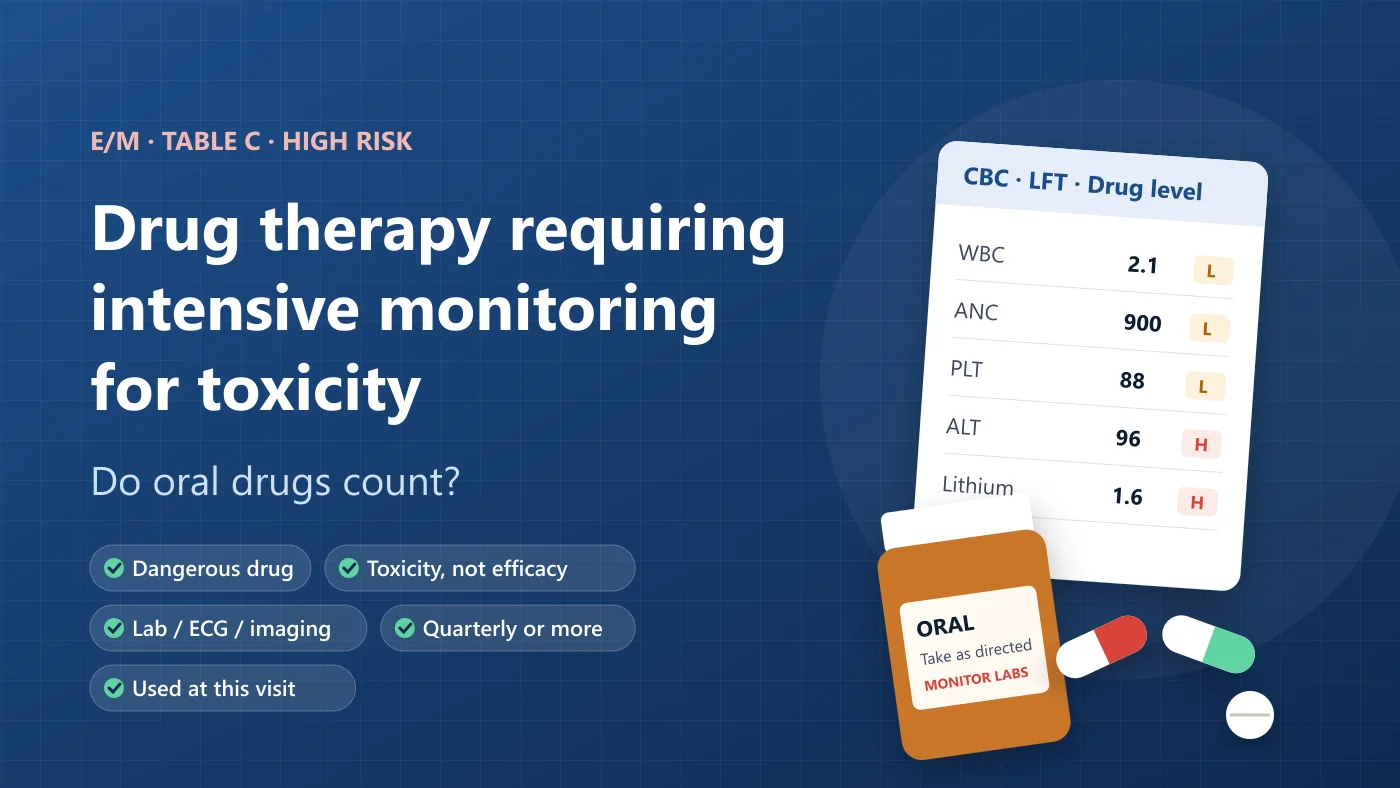
In this article
"Drug therapy requiring intensive monitoring for toxicity" is one of the high-risk examples in Table C of medical decision making (MDM). Coders often ask whether it applies only to IV chemotherapy. It doesn't. Neither CPT nor CMS mentions the route of administration. An oral drug counts when its monitoring meets the definition, and an IV drug doesn't count when it doesn't.
Part 1 of 4
The CPT definition
The AMA's E/M guidelines define it like this:
A drug that requires intensive monitoring is a therapeutic agent that has the potential to cause serious morbidity or death. The monitoring is performed for assessment of these adverse effects and not primarily for assessment of therapeutic efficacy. The monitoring should be that which is generally accepted practice for the agent but may be patient-specific in some cases. Intensive monitoring may be long-term or short-term. Long-term intensive monitoring is not performed less than quarterly. The monitoring may be performed with a laboratory test, a physiologic test, or imaging. Monitoring by history or examination does not qualify. The monitoring affects the level of MDM in an encounter in which it is considered in the management of the patient.
The five tests
| # | Test | What to look for in the note |
|---|---|---|
| 1 | Dangerous drug | It can cause serious morbidity or death |
| 2 | Toxicity, not efficacy | The test looks for harm (cytopenia, hepatotoxicity, toxic level) |
| 3 | Objective test | Lab, physiologic test (e.g., ECG) or imaging, not history or exam alone |
| 4 | Often enough | Long-term: at least quarterly. Short-term (start or titration): more frequent |
| 5 | Considered at this visit | Results reviewed or ordered and used in today's management |
Done: Definition and the five tests
Part 2 of 4
Toxicity or efficacy?
CPT's examples show the line:
- Qualifies: monitoring for cytopenia with an antineoplastic agent between dose cycles.
- Doesn't qualify: glucose checks during insulin therapy, because the main purpose is the therapeutic effect. The exception is when severe hypoglycemia is a current, significant concern.
- Doesn't qualify: annual electrolytes and renal function on a diuretic, because yearly testing is not frequent enough.
Frequent electrolytes and creatinine during active diuresis are commonly accepted as short-term intensive monitoring, but auditors differ, so document why the tests are needed.
Oral drugs: examples
No drug is automatically on or off the list. The same drug can be moderate risk for one patient and high risk for another.
| Oral drug | Usually high risk when… | Usually not when… |
|---|---|---|
| Warfarin | Restarting with several dose titrations and INRs, or vitamin K is needed | Stable dose, routine INR, small adjustments |
| Capecitabine, other oral chemo | CBC and chemistry checked between cycles for cytopenia or organ toxicity | Only symptoms are asked about |
| Methotrexate | CBC and LFTs at least quarterly (more often when starting or changing dose) | Labs are overdue and not discussed |
| Lithium | Lithium level and renal/thyroid tests reviewed for toxicity | Stable patient, levels twice a year, not discussed |
| Tacrolimus, cyclosporine | Trough levels and creatinine reviewed and the dose adjusted | Refill only, no levels in the visit |
The warfarin row comes from Medicare contractor guidance. CGS (MAC for J15) says routine lab checks with slight dose changes in a chronically anticoagulated A-fib patient are not intensive monitoring, but a patient restarted after surgery who needs several dose titrations with labs, or vitamin K, is. The other rows apply the CPT definition. They are not a CMS list.
Done: Toxicity vs. efficacy; oral drugs
Part 3 of 4
Which E/M services use this?
Since 1 January 2023, the same MDM table applies to office (99202–99215), hospital inpatient and observation (99221–99223, 99231–99236), emergency department (99281–99285), nursing facility (99304–99310), home or residence (99341–99350) and consultation codes (99242–99245, 99252–99255). Remember that Medicare doesn't pay the consultation codes, so you bill the office or hospital visit code instead.
High risk is one element, not the whole visit
Risk is only one of the three MDM elements. To report high MDM (99205, 99215, 99223, 99233, 99306, 99310…), two of three elements must be high. Intensive monitoring with a stable chronic illness and limited data is still moderate MDM.
Documentation checklist
- Name the drug and dose.
- Name the test and its result (for example, "WBC 2.1, ANC 900").
- Say the test is for toxicity (for example, "CBC for methotrexate marrow suppression").
- Show the plan: hold, reduce, continue at the same dose, or recheck in a set number of days.
- For long-term therapy, show the schedule ("CBC/LFT every 8 weeks").
Done: Settings, MDM level and documentation
Part 4 of 4
Oral methotrexate
A patient with rheumatoid arthritis takes methotrexate 15 mg weekly. CBC and LFTs are done every 8 weeks. Today the ALT is twice normal. The physician reduces the dose to 10 mg and orders repeat LFTs in 4 weeks.
Reveal answer & rationaleHide answer
Stable warfarin
A patient with atrial fibrillation has taken warfarin for three years. The INR is 3.2, the weekly dose is reduced slightly, and a recheck is planned in four weeks.
Reveal answer & rationaleHide answer
For the full risk table, see Table C: Risk of Patient Management. Test yourself with the Intensive Monitoring practice test (12 questions).
Done: Two cases and a quiz